
Fundamental Analysis for Forex
Understanding the Economic Forces Behind Currency Markets
Currency prices do not move only because of chart patterns. They also respond to changes in economic expectations, central-bank policy, inflation, growth, employment and political decisions.
Fundamental analysis is the process of studying these broader forces to understand why demand for one currency may strengthen or weaken relative to another.
Key themes: Interest Rates • Inflation • GDP • Housing • Employment • Government & Central Banks • Event Risk
1. What Is Fundamental Analysis?
In Forex, fundamental analysis looks beyond the price chart and focuses on the condition and expected direction of an economy.
Because currencies are traded in pairs, the question is not simply whether one economy is “strong” or “weak”. The more useful question is how its outlook compares with the economy behind the other currency in the pair.

Traders therefore pay attention to economic releases, policy decisions and changes in expectations. A data release can matter because it changes what market participants expect central banks, consumers and businesses to do next—not simply because the number itself is high or low.
Fundamental analysis is comparative: one currency is always being valued against another.
2. Interest Rates: Why Central Banks Matter
Interest rates are one of the most closely watched parts of currency analysis. Central banks adjust policy rates as part of their efforts to influence inflation, borrowing, saving and overall economic activity.

All else equal, higher interest rates can make assets denominated in a currency more attractive because investors may be able to earn a higher return. This can increase demand for that currency.
Lower rates can have the opposite effect by encouraging borrowing and spending while reducing the relative return available to savers.
What Should a Learner Watch?
The market often reacts not only to the rate decision itself, but also to the central bank’s language and the gap between the decision and prior expectations.
A widely expected rate change may have less impact than a surprise change in the future policy outlook.
3. Inflation: CPI, PPI and Purchasing Power
Inflation describes a sustained rise in the general price level. As prices rise, the purchasing power of money falls: the same amount of currency buys fewer goods and services.

Inflation matters to Forex because it can influence central-bank policy. Persistent price pressures may lead policymakers to consider tighter monetary conditions, while very weak inflation or deflation can create a different set of economic concerns.
CPI and PPI
Two commonly followed measures are the Consumer Price Index (CPI) and Producer Price Index (PPI).
CPI focuses on price changes from the consumer’s perspective, while PPI looks at prices faced or received by producers and suppliers. They measure different stages of the pricing process and can therefore tell slightly different stories.
4. GDP: A Broad Measure of Economic Activity
Gross Domestic Product (GDP) measures the market value of final goods and services produced within an economy over a specified period.
Changes in GDP are widely used to describe whether economic activity is expanding or contracting.

Rather than treating GDP as a single isolated number, it is useful to understand the activity underneath it. The course highlights consumer spending, government spending, business investment and the balance of trade as important components.
Component | What it tells us |
Consumer spending | How households are spending on goods and services |
Government spending | Public-sector expenditure, such as education, healthcare or defence |
Business investment | Spending by businesses on assets used to produce goods and services |
Balance of trade | The difference between the value of exports and imports |
5. Housing as an Economic Signal
Housing activity can provide clues about household confidence, financing conditions and the broader economy.
Property purchases are large financial commitments, so changes in housing activity can reflect shifts in borrowing costs and consumers’ willingness or ability to spend.
The source lesson focuses on pending home sales, existing home sales and new home sales. These measures capture different stages and segments of housing-market activity.
Pending home sales track transactions where a contract has been signed.
Existing home sales measure completed transactions involving previously owned homes.
New home sales measure sales of newly built homes.
6. Employment and the Economic Cycle
Employment is closely linked with economic output and consumer spending. When more people are working and earning income, household spending can support business activity.
Weak labour-market conditions can reduce spending and may also signal weaker demand or business confidence.

US Nonfarm Payrolls (NFP)
The lesson gives particular attention to US Nonfarm Payrolls, a major US labour-market release. It includes information about payroll employment and is closely watched because labour conditions can influence expectations for growth and monetary policy.
The important learning point is not to assume that a “good” employment number must automatically produce a predictable currency move. The market’s prior expectation, revisions, wages, unemployment data and positioning can all affect the reaction.
7. Government Policy vs Central-Bank Policy
Governments and central banks influence the economy through different policy channels.
Government decisions are generally discussed under fiscal policy, while central-bank decisions fall under monetary policy.

Government | Central bank | |
Policy area | Fiscal policy | Monetary policy |
Main tools | Taxation and government spending | Interest rates and money-supply conditions |
Why markets watch it | Can affect growth, demand and the economic outlook | Can affect financing conditions, inflation expectations and currency demand |
Hawkish and Dovish
Central-bank communication is often described as hawkish or dovish.
In the source material, a hawkish stance is associated with a preference for higher rates and controlling inflation, while a dovish stance is associated with lower rates intended to encourage borrowing and spending.
These labels describe policy tendencies rather than guaranteed future decisions.
8. Why “Better Data” Does Not Always Mean a
Stronger Currency
One of the most important limitations of fundamental analysis is that financial markets are forward-looking.
Prices can move before an announcement because traders have already positioned for what they expect to happen. This is often described as an event being “priced in”.

Market reaction = actual result + expectations + prior positioning + interpretation
For example, if a rate cut has been anticipated for weeks, traders may have already sold the currency before the official decision.
When the cut is finally announced, some of those positions may be closed, creating a reaction that appears to contradict the headline.
9. Event Risk and Fundamental Trading
Major announcements such as interest-rate decisions and employment releases can produce rapid price changes, wider spreads and increased short-term volatility.
The source lesson specifically warns that being on the wrong side of a highly volatile announcement can result in substantial losses.
For beginners, the key lesson is that fundamental analysis is not a formula that converts an economic number into a guaranteed trade direction. It is a framework for understanding the forces that may be influencing market expectations.
10. A Simple Framework for Reading Economic News
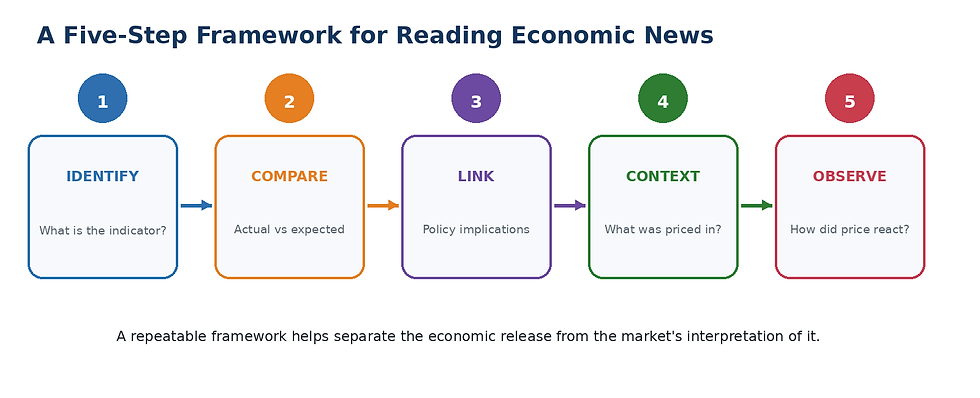
1. Identify the indicator
Is the release about inflation, growth, employment, housing or policy?
2. Compare actual vs expected
Was the result stronger or weaker than the market consensus?
3. Consider the policy link
Could the data change expectations for interest rates or government policy?
4. Check what was already priced in
Had the market been moving in anticipation before the release?
5. Observe the reaction
Price action after the announcement can reveal how the market interpreted the information.
Key Takeaways
Fundamental analysis: Studies economic, political and policy forces that may influence currencies.
Interest rates: Can affect borrowing, saving, capital flows and currency demand.
Inflation: Is closely watched because it can influence purchasing power and central-bank policy.
GDP: Provides a broad view of economic activity and growth.
Housing and employment: Can offer additional signals about the strength of an economy.
Fiscal and monetary policy: Operate through different institutions and tools.
Expectations matter: Markets can move before the official data or policy announcement.
Educational Notice: This material is provided for educational purposes only. It explains general concepts related to fundamental analysis and financial markets and does not constitute investment advice, a personal recommendation, or an offer or solicitation to buy or sell any financial instrument. Market reactions to economic events are uncertain, and leveraged trading involves significant risk.


Comments